Service Dog Tasks and the Public Access Test, Explained
This page explains the law in general terms. It is not legal advice. For a specific situation, contact the agency listed on this site or an attorney.
Two ideas sit at the center of service dog training in Arizona: the tasks a dog performs for a person with a disability, and the public access test used to check that the dog behaves well in public. They are often mixed up. One is the legal core of what makes a dog a service dog. The other is a training benchmark.
This guide explains both, then walks through how to train toward each step by step with humane, reward-based methods in line with the American Veterinary Society of Animal Behavior (AVSAB). It is general information, not legal advice.
What Counts as a Task
The ADA.gov service animal FAQ says a service animal is a dog that has been individually trained to do work or perform tasks for an individual with a disability. Arizona's statute, A.R.S. 11-1024, uses similar wording. It covers a dog or miniature horse that is individually trained, or in training, to do work or perform tasks for the benefit of a person with a disability.
The key phrase is work or tasks. The dog must do something specific that helps with the disability. Being present, being friendly or being well behaved is not enough on its own.
Tasks by disability
Task training is individual. What a dog learns depends on what its handler needs. These are types of tasks, not a complete list:
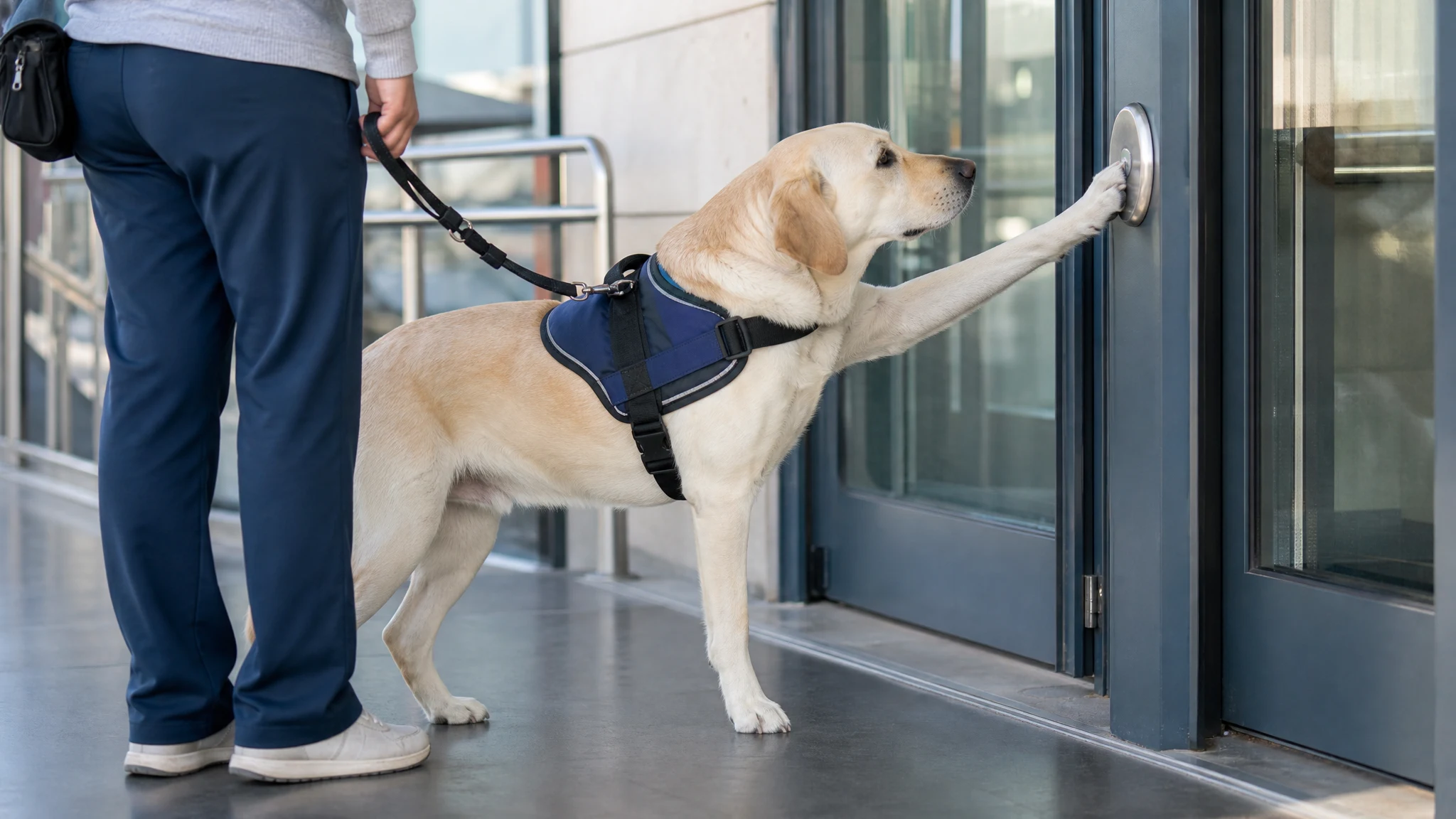
- Mobility disabilities: retrieving dropped items, opening or closing doors, or providing balance support or bracing.
- Hearing disabilities: alerting the handler to a sound, such as a doorbell, an alarm or a person calling their name.
- Diabetes: alerting the handler to a change in blood sugar before they would otherwise notice it.
- Seizure disorders: responding during a seizure, for example by staying with the handler or going for help in a way that has been trained.
- Psychiatric disabilities, including PTSD: interrupting a harmful behavior, turning on lights or creating space in a crowd on cue.
Ability Dogs of Arizona, an Assistance Dogs International (ADI) accredited program according to its own site, lists veterans, children with disabilities, diabetic alert, hearing, mobility, psychiatric and seizure response among the areas it serves. That gives a sense of how wide the range is.
Why comfort alone is not a task
Emotional support, therapy and comfort animals are not service animals under the ADA. A.R.S. 11-1024 is just as direct. It says emotional support, comfort and crime deterrence are not work or tasks.
The line is the trained action. A dog that calms its owner by being nearby is providing comfort. A dog that has been trained to apply pressure on cue during a panic episode, or to wake its handler from a nightmare, is performing a task directly related to the disability.
One Arizona wrinkle is housing. A.R.S. 41-1491 defines an assistance animal for the state fair housing act as a trained or untrained animal that provides assistance, tasks, or therapeutic or emotional support to a person with a disability. That is broader than the public-access definition. A dog can fall under the housing definition without being a service dog for public access.
What the Public Access Test Is, and What It Is Not
Public access testing is a way to check that a dog can work calmly around people, traffic, food and other animals. Programs accredited by Assistance Dogs International use a public access test as a standard for their teams. Many private trainers and owner-trainers use a similar test as a benchmark too.
It is not a legal requirement. The ADA has no official service dog registry and no required certification, and it does not require passing any test. Arizona's A.R.S. 11-1024 does not create one either. No online registration or ID card is legal proof of anything. Check with ADI directly for the current text of its test.
The law cares about two things in public. The dog is trained to do tasks, and the dog is under control. Under A.R.S. 11-1024, an animal may be excluded if it is out of control and the handler does not take effective action, or if it is not housebroken. A public access test is a practical way to prepare for those conditions.
Materials You Will Need
- Small, soft, high-value treats and your dog's regular food for rewards.
- A flat buckle collar or a well-fitted harness, and a standard leash. Do not use shock, prong or choke collars.
- A clicker or a consistent marker word such as "yes" (optional but useful).
- A mat or small rug for settle practice.
- A treat pouch, so rewards are quick and your hands stay free.
- A training log, on paper or on your phone, to record sessions and note progress.
- Permission and a plan for each new location, since practice outside the home should be gradual.
Step-by-Step: Training Tasks and Public Manners
Step 1: Write down the disability-related need
Start with the problem the dog will help with, not the trick. Describe a specific moment, such as "I cannot bend to pick up my keys" or "I do not hear the smoke alarm." The task should answer that need directly. If you cannot name the need, you do not yet have a task.
Step 2: Break the task into small pieces
Most tasks are chains of simple behaviors. A retrieve, for example, is orient to the item, mouth it, hold it, bring it to hand and release. Teach each piece separately with a marker and a treat, then link them. Keep sessions short, a few minutes at a time, and end on a success.
Step 3: Put the task on cue and make it reliable
Add a cue word or signal once the dog performs the behavior consistently. Then practice in new rooms, with new distractions and at different times of day. For alert tasks, work with the trainer or program that is guiding you, because teaching a dog to respond to a medical change takes careful, individualized setup.
Step 4: Build the foundation behaviors
Public work depends on a few basics: a settle on a mat, a loose leash, a reliable sit and down, a recall, and the ability to ignore food on the floor. Reward calm choices often. A dog that learns that quiet, relaxed behavior earns the good things is easier to take anywhere.
Step 5: Teach neutrality around people and dogs
Practice at a distance from strangers and other dogs, and reward your dog for looking at you instead. Shrink the distance slowly. The goal is a dog that notices the world and chooses to stay with its handler. If your dog pulls, barks or fixates, you moved too fast. Add distance and try again.
Step 6: Practice real public settings in stages
Begin in quiet outdoor areas, then move to busier ones: parking lots, a pet-friendly store, then places with slick floors, automatic doors, elevators and crowds. Under A.R.S. 11-1024(G), a trainer or an individual with a disability may take an animal being trained as a service animal to a public place. The summary available to us did not state age, harness or ID conditions, so confirm details in the statute itself or with the Arizona Attorney General's Office.
Step 7: Rehearse restaurant and travel manners
Teach the dog to settle under a table or beside a chair without begging, to wait calmly at doorways, and to ride quietly in a car or on transit. Practice for longer periods in small increments. Watch for stress signals such as lip licking, yawning, panting or stiff posture, and take breaks.
Step 8: Run a mock public access test
Once the dog is steady, walk through a full outing as if you were being observed. Include entering a building, a busy walk, a settle, a pass by another dog and an exit. Ask a trainer or an experienced handler to watch and give feedback. Because the exact scoring of the ADI test is set by ADI, look at their current materials before you decide what "passing" means for you.
Step 9: Keep the dog's health and welfare first
A working dog needs rest, play and regular veterinary care. Stop a session if the dog seems tired, sore or overwhelmed. Retire a task or an outing that is causing stress, and ask your veterinarian or a qualified trainer about any change in behavior.
Tips for Success
- Reward the behavior you want in the moment, then fade treats gradually and keep a few in reserve for hard environments.
- Train one new thing at a time. Change only the location or the distraction, not both.
- Keep notes on what worked. Patterns show up quickly in a log.
- Choose practice times when a location is quiet, such as early mornings, especially in Arizona summer heat. Check pavement with the back of your hand and carry water.
- Work with a reward-based trainer or a program if you want guidance. Ability Dogs of Arizona and Power Paws Assistance Dogs are listed by ADI as Arizona members, and each states its own ADI accreditation. Contact them directly about services, costs and waitlists, since those details were not available to us.
Common Mistakes to Avoid
- Treating comfort as a task. Calming presence is valuable, but it does not meet the ADA or Arizona definition by itself.
- Buying a registration or certificate. There is no official registry or required certification, and a purchased card does not give legal access rights.
- Rushing into crowds. A dog that practices being overwhelmed learns to be overwhelmed. Build up in steps.
- Using punishment-based tools. Shock, prong and choke collars, alpha rolls, scruffing and dominance methods are not part of humane training, and they can damage trust and increase fear.
- Skipping the housebreaking check. A dog that is not housebroken can lawfully be excluded under A.R.S. 11-1024.
- Calling a pet a service dog. Fraudulently misrepresenting an animal as a service animal can bring a civil penalty of up to $250 per violation under A.R.S. 11-1024(K).
What to Expect from Access in Arizona
Under A.R.S. 11-1024, public places may not discriminate against a person with a disability who uses a service animal whose tasks relate to the disability. Staff can ask only two questions, according to the ADA.gov service animal FAQ: whether the dog is a service animal required because of a disability, and what work or task the dog has been trained to perform. They may not ask for documentation or ask about the nature of the disability.
An animal may be excluded for direct threat, fundamental alteration, undue burden, being out of control without effective handler action, or not being housebroken. Even then, the person must still be allowed to obtain goods or services without the animal. The handler is liable for any damage the dog causes. Violating the access provisions is a class 2 misdemeanor under the statute.
One practical detail: A.R.S. 11-1008 bars counties from charging a dog license fee to an individual with a disability who uses a service animal. The applicant signs a written statement that the dog is a service animal as defined in A.R.S. 11-1024, and a false statement is a petty offense with a fine of up to $50.
For wider context on Arizona law, programs and costs, see the guide to service dog training in Arizona.
Expected Results
Results vary with the dog's temperament, the handler's consistency and the complexity of the task. Many teams may find that simple tasks become reliable over weeks to months, while public manners and alert work can take much longer. A dog may not suit service work at all, and that is a welfare decision, not a failure.
A mock public access test can help show where a team is strong and where it needs more practice. It does not prove legal status, and passing it does not guarantee access in every situation. If your rights are denied, you can file a complaint with the Arizona Attorney General's Office, Civil Rights Division, which lists public accommodation as a complaint category. The office is at 2005 N Central Ave, Phoenix, AZ 85004, and its phone number is (602) 542-5025. Complaints go through the Civil Rights Intake Questionnaire.